
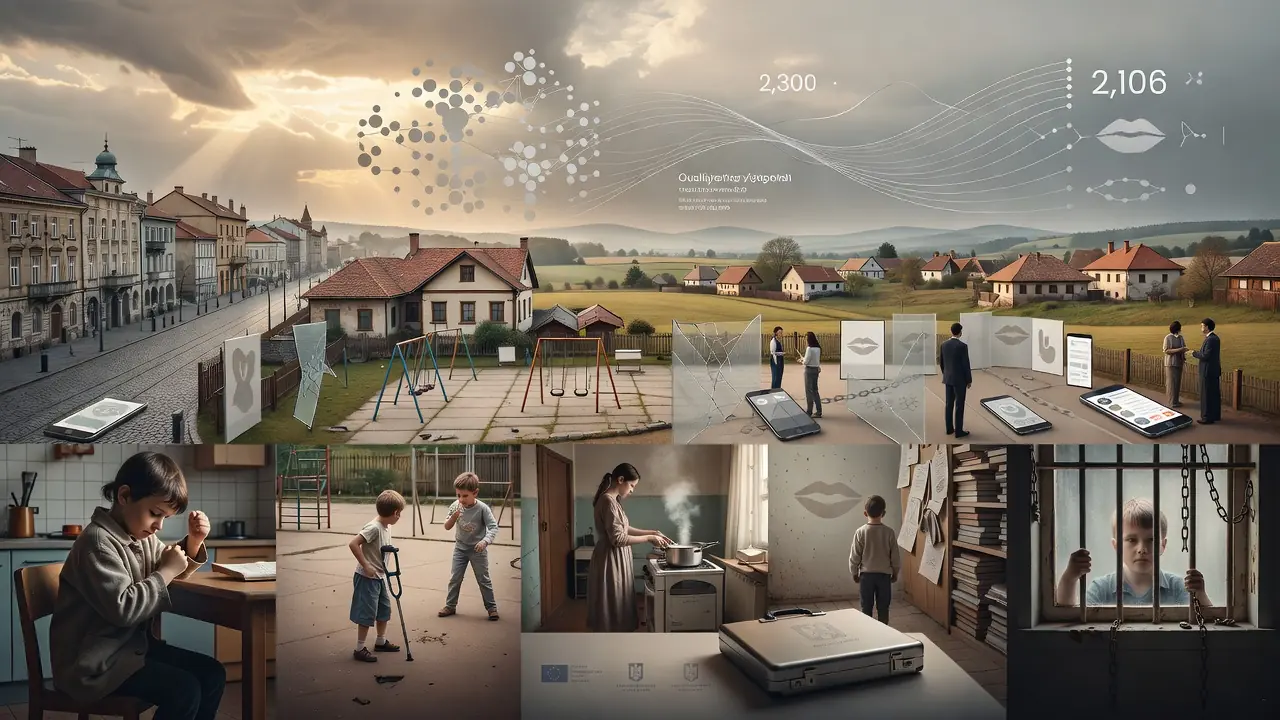
A new national prevalence study in Romania maps how often children experience violence in the places where they live, learn and socialize, and why many cases never reach help. Led by the National Authority for the Protection of Child Rights and Adoption with support from UNICEF Romania, the research follows the International Classification of Violence Against Children, which covers every setting a child moves through, including online spaces.
How the study was built
The project combined a nationally representative survey of 2,106 respondents, made up of children and parents, with a qualitative component that drew on more than 300 children. Those participants included Roma children, children with disabilities, children whose parents work abroad, children in alternative care, children in detention and adolescent mothers. Researchers also interviewed 48 professionals and representatives of central institutions and non-governmental organizations. Pairing numbers with direct accounts from groups that are often underrepresented gives the findings more depth than a survey alone could provide.
The gap between disclosure and protection
According to the study, the central problem is not only that violence occurs across children's everyday environments but that few children who experience it can reach protection and support. Social norms that normalize or minimize certain forms of violence make those situations harder for children, families and adults to recognize, and therefore harder to report. When a behavior is seen as ordinary discipline or simply part of growing up, it may never be named as abuse at all.
What happens next
The authors say the findings and recommendations are meant to guide public policy and the design of prevention and response services suited to children's specific needs. The study was funded by the European Union through its Technical Support Instrument and carried out at the request of Romania's Ministry of Labor, Family, Youth and Social Solidarity and the Ministry of Justice of Poland, with technical assistance from UNICEF Romania and UNICEF Poland. Its practical value will depend on how quickly those recommendations are translated into services that children can actually reach.