
A Curtin University-led study of Australian adults finds that the home, not institutions, is where most reported childhood physical abuse takes place, and that much of it begins in early childhood. The findings point prevention efforts toward families and toward support for parents at the stage when help can have the greatest effect.
What the study measured
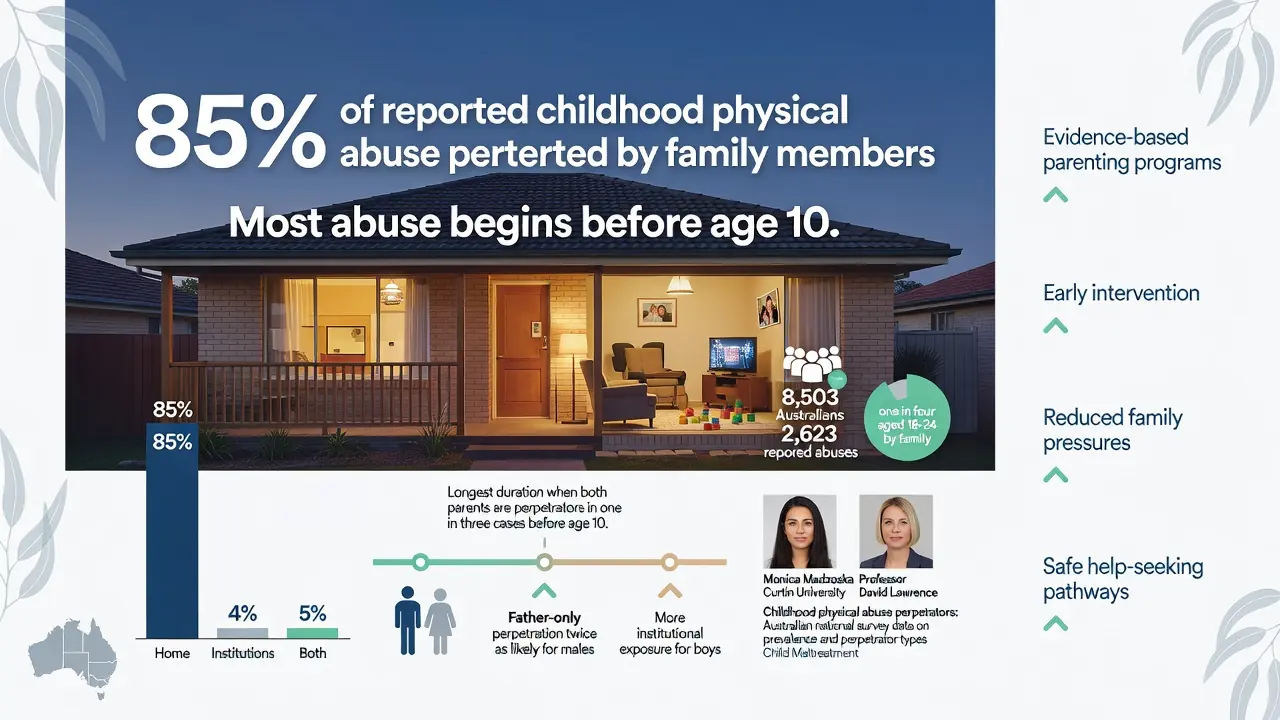
Researchers drew on data from the Australian Child Maltreatment Study, covering 8,503 Australians aged 16 and older. The analysis focused on 2,623 people who reported childhood physical abuse. Reported experiences ranged from being hit, punched or kicked by an adult to more severe acts such as being beaten, choked, burned, or hit on the head or face.
Where the abuse happened and who was responsible
Family members were responsible for 85% of the reported perpetration. Institutional settings accounted for 4%, and 5% involved both settings. Among young adults, one in four aged 16 to 24 reported physical abuse by a family member. Among children abused before age 10, both parents were identified as perpetrators in one in three cases. Those cases were associated with the earliest onset and the longest duration of abuse.
Differences among male victim-survivors
Among male victim-survivors, father-only perpetration was twice as likely as mother-only perpetration. Men also reported considerably more institutional physical abuse, which the researchers suggest reflects greater historical exposure of boys to punitive institutional environments.
What the researchers recommend and what the study does not show
Lead author Monica Madzoska said prevention must extend beyond institutions and place greater emphasis on the home. The researchers call for evidence-based parenting programs, measures to reduce pressures on families, early intervention, and ways for children to safely seek help. Co-author Professor David Lawrence described childhood physical abuse as a major global public health concern linked to lasting mental, physical and social harm. The study is a survey of retrospective self-reports, so it reflects what adults recalled and disclosed rather than verified case counts, and it cannot by itself establish which programs would reduce abuse. The findings were published in Child Maltreatment under the title "Childhood physical abuse perpetrators: Australian national survey data on prevalence and perpetrator types."