
Parents who serve in the U.S. armed forces, veterans, and the spouses of service members face pressures that many civilian families never encounter. A research team at the NYU Silver School of Social Work is now testing whether a structured parent-child intervention can ease the trauma symptoms these families carry and strengthen how parents and children relate to each other.
Why Childhood Trauma Matters Most
Kathrine S. Sullivan, an associate professor at the NYU Silver School who studies trauma in highly stressed family systems, describes military-connected parents as, on the whole, "remarkably resilient." Her research group has found that combat experience and other military-specific stressors are less predictive of PTSD and related mental health challenges in adulthood than traumatic experiences in childhood.
Military service can still expose people to more trauma than most civilian work, Sullivan notes. Repeated exposure can worsen mental health symptoms, so a parent with a childhood history of trauma who also faces further trauma through their own service or a spouse's service may be at particular risk. Sullivan points out that military families are not a single group, and that service can bring both pride and connection alongside hardship and sacrifice.
How the P-STAIR Approach Works
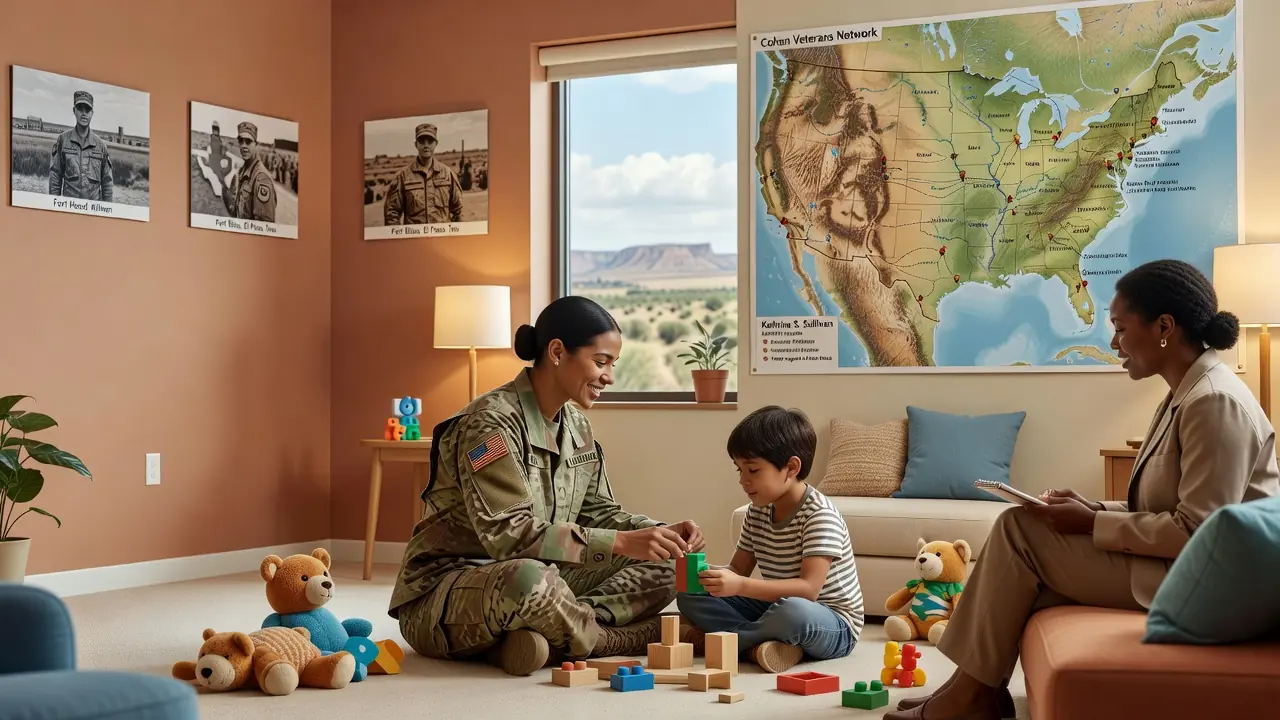
The team is testing an existing trauma-informed model called Parenting-Skills Training in Affective and Interpersonal Regulation, or P-STAIR. The protocol has two phases. In the first, a clinician works with the military-involved parent in therapy to examine and address trauma symptoms. In the second, the clinician watches the parent play with the child and gives real-time, research-backed feedback aimed at a more positive, responsive relationship.
According to Sullivan, participants in earlier applications of P-STAIR showed better emotion regulation, fewer PTSD and depression symptoms, less parenting stress, fewer negative parenting behaviors, and stronger positive parenting skills. Sullivan says these changes are associated with closer parent-child relationships and improvements in children's behavior, and may reduce the risk of child maltreatment. Lindsey adds that a parent who becomes more attuned to their own trauma symptoms can produce effects for the child that may last across the child's life.
The Two Studies and Their Limits
- A study supported by the National Institute of Child Health and Human Development began in 2024 and runs through 2027. It is recruiting 120 military-involved mothers of children ages 2 to 10 near Joint Base San Antonio, Fort Hood in Killeen, and Fort Bliss in El Paso, Texas.
- A parallel study supported by the U.S. Army Medical Research Acquisition Activity launched in September and will last four years. It includes active duty service members or their spouses, including fathers, and plans to enroll 162 parent-child pairs in the mid-Atlantic region, Colorado, and Oklahoma, plus 81 in Korea.
Both studies work with the Cohen Veterans Network, a not-for-profit network of mental health clinics focused on reducing barriers to care for veterans and military families. Earlier work by the same researchers applied P-STAIR to families with open child welfare prevention cases and reported significant post-treatment improvements in mothers' PTSD and depression symptoms, parenting skills, and use of nonviolent discipline and psychological aggression. Those findings come from a specific population and do not by themselves establish how the approach will perform in active military families, which is the question the current studies are designed to answer.
For families weighing their options, the research is not yet a treatment recommendation. Enrollment is limited to the locations and criteria described in the studies, and final results are not yet available. Anyone seeking support now can ask a primary care provider, a military family support office, or a licensed mental health clinician about evidence-based options that are available locally.